SenescenceAssociated Proinflammatory Cytokines and Tumor Biology Diagrams Cellular senescence is a highly stable cell cycle arrest that is elicited in response to different stresses. By imposing a growth arrest, senescence limits the replication of old or damaged cells. A variety of stressors induce senescence-associated growth arrest. Cell cycle exit is regulated by induction of the p16 INK4a /Rb and p53/p21 These changes have been linked to both the cell-autonomous and paracrine aspects (that is, the effect on surrounding cells) of senescence-associated proliferation arrest. Senescence-associated The senescence-associated irreversible cell-cycle arrest is mainly characterised by the activation of two cyclin-dependent kinase inhibitors, p21 WAF1/Cip1 (p21) and p16 INK4a (p16), which halt cell-cycle progression in G0/G1 phase. Although extensively used as a senescence biomarker, activation of a state of irreversible growth arrest is
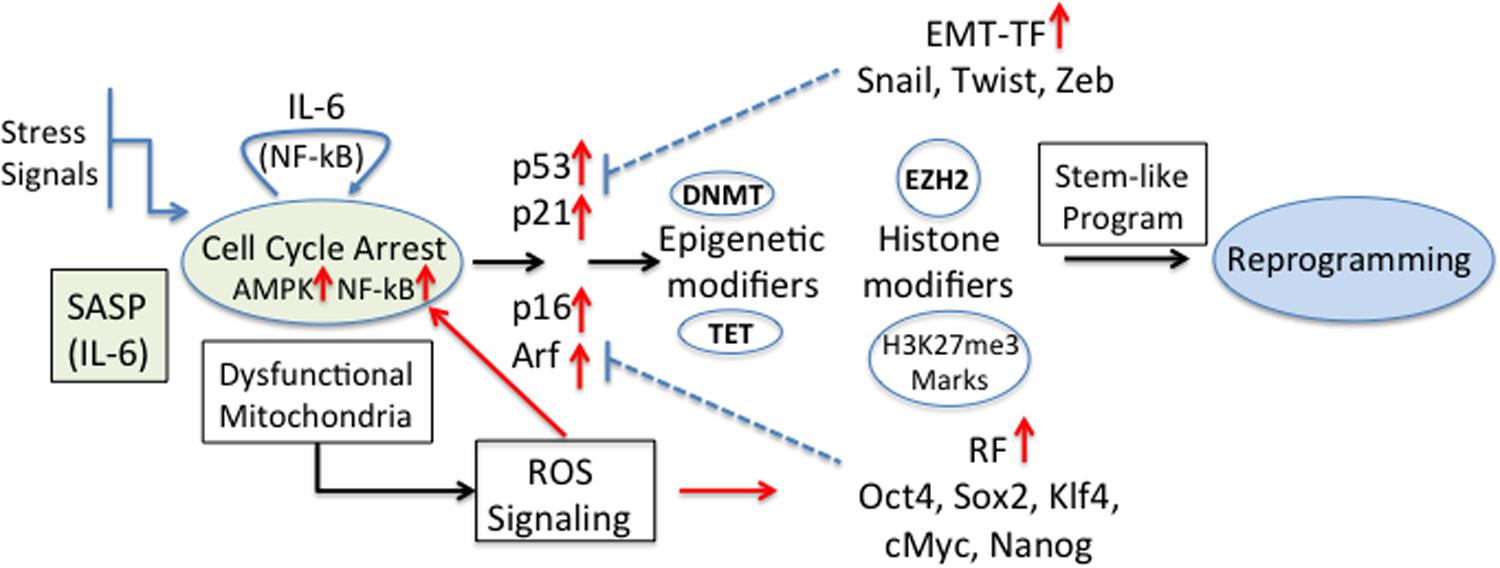
Loss of SIRT1 activity is associated with multiple aspects of senescence, including SASP activation 91 and cell cycle arrest 92, as well as several senescence-associated degenerative pathologies Cellular senescence is a tumour suppressor programme characterized by a stable cell cycle arrest. Here we report that cellular senescence triggered by a variety of stimuli leads to diminished (D-G) Transcriptional expression of cell cycle arrest markers (p16 INK4a, p21 WAF1) and SASP factors (IL-6, IL-1b) within the hippocampus of vehicle-treated cognitively stratified and senolytic-treated aged male mice. (H, I) Quantification and representative images of senescence-associated beta-galactosidase staining within the hippocampus.

Biomarkers of Cellular Senescence and Aging: Current State‐of‐the‐Art ... Biology Diagrams
Cellular senescence is a major driver of age-related diseases, and senotherapies are being tested in clinical trials. Despite its popularity, cellular senescence is weakly defined and is frequently referred to as irreversible cell-cycle arrest. In this article we hypothesize that cellular senescence is a phenotype that results from the coordination of two processes: cell expansion and cell 1 Introduction. In 1961, Hayflick and Moorhead first defined cellular senescence in human fibroblasts and reported that cell proliferation is arrested in embryonic tissues after a few cell divisions. [] Senescence, a lifelong physiological mechanism for stable cell-cycle cessation, is defined as cell-cycle arrest in either the G1 or G2 phase to stop the proliferation of damaged cells. []

